Convoluted Self-Portrait
An installation that reflects on infiltration and surveillance.
This is a video installation inspired by Nam June Paik’s “TV Buddha”.
Final Video

Description
“Convoluted Self-Portrait” is a reflection of our self-perception in the digital age, where our identities are constantly mediated through screens. This mirrored self-portrait demonstrates a feedback loop of images, capturing how live media may distort and reinterpret our sense of self. Each layer through screens, cameras, and shifting perspectives (e.g. FaceTime) fragments and abstracts the original image, revealing a layered version of ourselves that is both familiar and foreign.
The installation draws inspiration from the ways we collectively interact within digital spaces, questioning whether the person we see online is true-to-life or merely a construct of pixels, angles, and compression artifacts. As resolution is lost and viewpoints multiply, the portrait becomes an evolving, shifting entity; one that mirrors the fragmented and networked nature of online identity.
The idea to reinterpret the body through FaceTime and webcams came about when we first considered our own mobile phones as extensions of our person. From there, we wanted to explore the idea of the “network”, and what digital interconnection means for self identity. How might digital perceptions, both direct and indirect, affect our online personas? Do we recognize ourselves in these filtered, refracted versions, or are we seeing someone else entirely? The role of the viewer might further complicate our notions of persona, as they also actively participate in the image feedback loop by interacting with the installation.
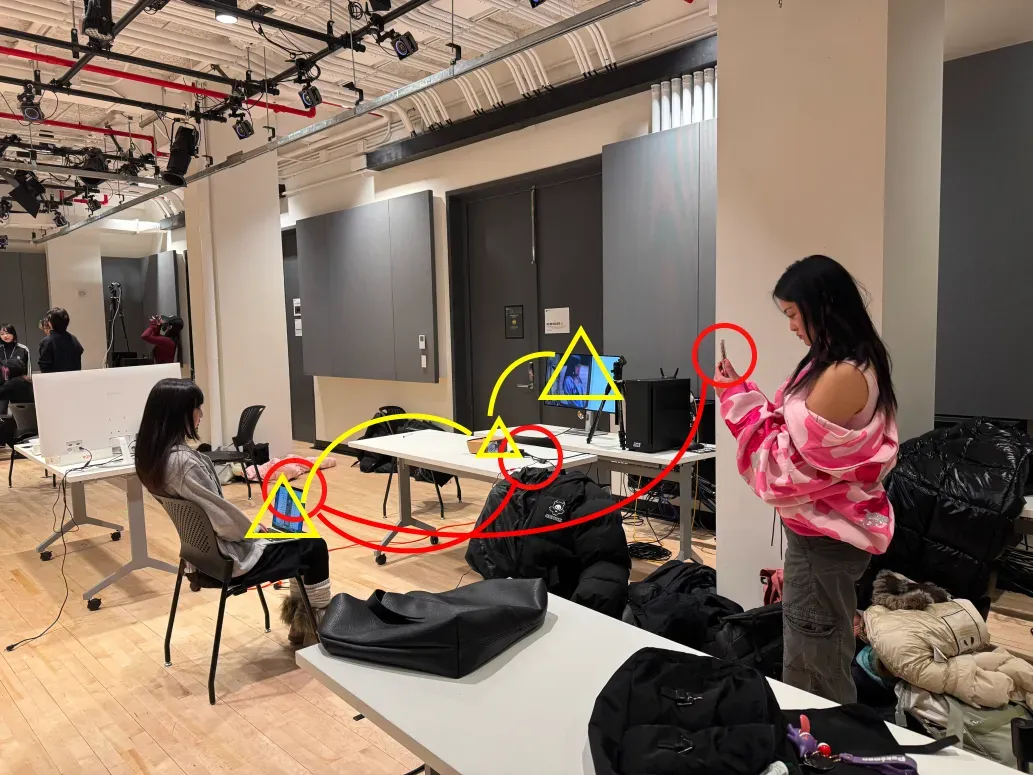
Project Set-up Explained
Phone 1 (Holding) ——FaceTime—→ Phone 2 (On the table) → Analog Camera → Big Monitor