The progressive hierarchy between fiction and truth
I agree with this sentence:
Culture is the software for our DNA hardware.
However, I think that merely viewing culture as a “software” is not enough to fully capture its complexity. As Yuval Harari mentioned in his talk, humanity’s strength lies not only in competition but also in cooperation. We can think of culture as a platform that carries many stories, and these stories are the foundational building blocks of human society.
Stories are not only the programming language of culture; they themselves are a positive force, the core hardware of human society. They are inevitable and an inseparable part of our lives. It is precisely these fictional stories—whether they be about nations, religions, money, or human rights—that enable us to cooperate with each other and build complex social structures.
As for whether we are more like chimpanzees or bees, it depends on the stories we choose to tell. Chimpanzee social structures are based on small-scale individual alliances, while the world of bees is built on a highly cooperative hive structure. What makes humans unique is our ability to cooperate in large groups through fictional stories, surpassing the capabilities of any other species. This enables us to transform and innovate from individual to group, and then to cross-cultural and cross-border levels, all within a short period.
Regarding the origin of stories, while Harari believes that these stories are human creations, I prefer to think they interact strongly with human reality. They are our attempts to understand the world, our dialogue with reality. Whether one is a theist or an atheist, humans seek meaning and direction in life through stories.
Regarding the question of computers, this talk reminded me of a meme:
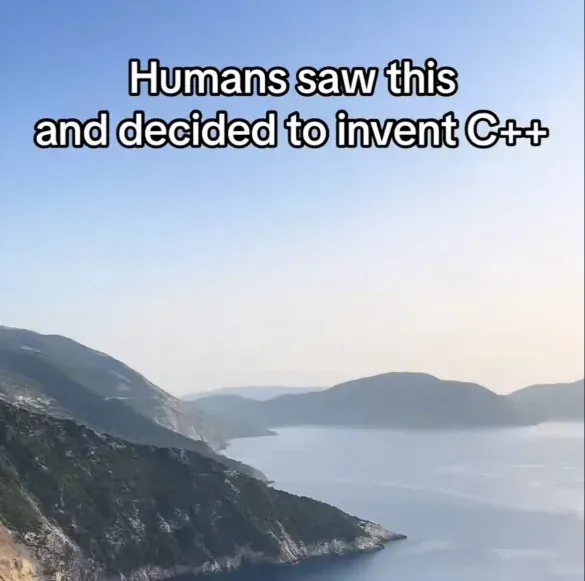
For clarity, (I hate to do this but) let me explain the joke: There’s a fascinating contrast between a complex technological invention (the C++ programming language) and a simple, pure natural landscape. A potential question arises here: should we consider the technologies and concepts we’ve created as “man-made constructs of fiction”? This meme can actually be deconstructed using Harari’s talk.
- Are stories man-made constructs of fiction?
From a certain perspective, one could say that stories are indeed human-made constructs of fiction. As Yuval Harari mentioned in his talk, many core foundations of human society—such as nations, human rights, corporations, and money—are “stories” constructed through shared beliefs and imaginations. These concepts do not physically exist, but they profoundly impact our real lives through collective human belief and action.
- Are our physical inventions built on concepts and symbols?
If we think carefully, many of our physical inventions are indeed built on concepts and symbols. A programming language like C++ is essentially a set of symbols and rules used to communicate with and operate computers, ultimately influencing the behavior of hardware in the physical world. A language like C++ is actually a “story,” a symbolic system created by humans to make machines understand instructions. Its existence and use enable us to perform complex computational tasks and achieve unimaginable technological breakthroughs. This is another way of connecting fictional things (symbols, logic) with the real world.
- Is there a relationship between fictional and real things?
Fictional concepts, stories, and symbols—like culture, religion, and law—provide a framework for humans to understand and manipulate reality. These fictional structures influence how we organize society, cooperate, and compete, and they also affect how we create inventions and technologies in the physical world.
For example, the monetary system is essentially a fictional concept that enables us to trade and build economic systems. No one can “see” the real value of money, as it is actually a product of human consensus. However, this consensus allows us to exchange actual goods and services on a global scale. Similarly, programming languages and software are fictional systems built on symbols and logic, but they have the power to directly change our physical world by manipulating machines, running networks, and designing advanced technologies.
Therefore, I believe that the relationship between fiction and reality is not oppositional but rather a progressive hierarchy. Fictional stories and concepts provide us with the “interface” to operate in the physical world, while our physical inventions and real-world achievements are the materialization and extension of these fictional concepts.