“Ah?”
Reading response to Christina Xu, Bullet Time
I’ve been a Bilibili user for over a decade, and reading the original article about bullet comments was both gratifying and frustrating. Yes, it explained what bullet comments are, those floating captions zipping across the video, but it only scratched the surface. As someone who practically grew up with Bilibili’s danmu culture, I want to share what that article missed. There’s a whole living, breathing culture behind those on-screen comments that you can only appreciate through experience. In the early days, I remember logging on to watch anime and feeling like I’d entered a rowdy theater where everyone had an equal right to yell witty remarks at the screen. The original piece treated bullet comments like a neat tech gimmick, but to us users, they’re so much more.
Repeating Bullet Comments
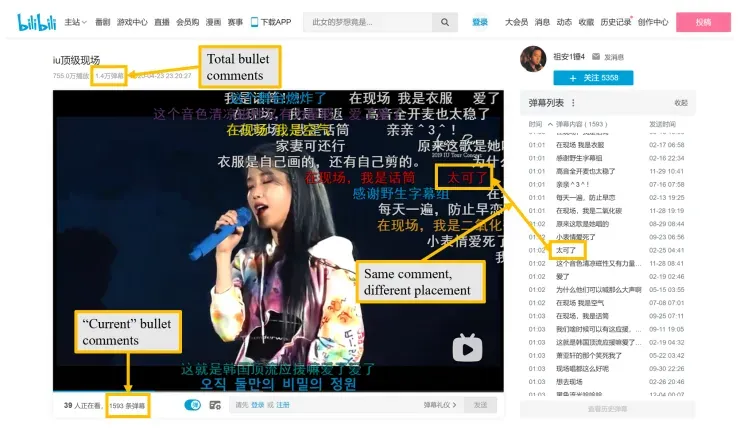
One of the first things a newcomer notices on Bilibili is how the same comment will appear over and over, launched by dozens of users simultaneously. It might be a catchphrase from the video, a meme, or just an expression of hype. I recall watching a pivotal episode of an anime where, the moment a character delivered a famous line, the screen exploded with that very line typed out by hundreds of fellow viewers. It was as if we were all shouting in unison, “Did you see that?!” – a spontaneous chorus only visible to those of us in the know. The original article didn’t mention this phenomenon of repeating bullet comments, yet it’s a core part of the danmu experience. When everyone spams the same phrase, it creates a thrilling sense of unity and occasion. In fact, through the continuous repetition of a single sentence, bullet comments “create a space of common knowledge and a visual spectacle”. It’s a digital ritual; by typing what dozens of others are typing, you feel connected to something bigger, a fleeting in-joke shared across thousands of screens.
Sometimes these repeated comments become so iconic that they transcend the video itself. Bilibili even has a tradition of highlighting the platform’s top bullet comment of the year. In 2023, for example, the most popular danmu was a simple exclamation: “Ah?” – used over 13.2 million times. Imagine that: millions of “Ah?” bubbles flying across countless videos, expressing collective surprise and amusement. A single Chinese character became a cultural phenomenon among us young users. This shows how a tiny bit of text, when echoed by enough people, turns into a shared emotional shorthand. The original article described bullet comments as commentary, but it missed how they can also be a cheer, a gasp, or a meme – a way for the audience to perform together. Anthropologists and media scholars have noted that sites like Bilibili and Niconico are arenas of affect where an “otaku” audience finds community through such pseudo-synchronicity and insider language. In plainer terms: even if I watch a video at 3AM alone in my room, seeing those familiar repeated comments scroll by makes me feel like I’m part of a live crowd, experiencing the moment together. That sense of togetherness is the real magic. It’s something a bullet-point list of features in an article can’t quite capture.
Fansub Legacy
Another aspect the article glossed over is how Bilibili’s bullet comment culture was born from the marriage of anime fandom and subtitle creation. Long before Bilibili was a publicly traded company hosting e-sports and vlogs, it was a humble hangout for die-hard ACG (anime, comics, games) fans and volunteer subtitle groups. We call them 字幕组 (subtitle teams) – passionate folks who translated and subtitled content out of love. I remember the early days when nearly every new anime episode on Bilibili came via these fan subbers. They weren’t just translating dialogue; they often added funny translator’s notes, inside jokes, or stylish typesetting that became part of the viewing experience. This fansub culture left an indelible mark on bullet comments. Many of us got into the habit of posting “谢谢字幕组” (Thank you, subbers) in the scrolling comments at the end of a video to show our gratitude. Over time, the Japanese-origin bullet comment concept fused with the Chinese subtitle group culture, resulting in a unique local danmu flavor. The original article didn’t mention this fusion at all.
Why does it matter? Because a lot of the memes, slang, and etiquette in Bilibili’s bullet chats can be traced back to fansub conventions and ACG fandom. For instance, the playful use of language – mixing Chinese with Japanese phrases or pop-culture references – is a nod to our otaku roots. A study noted that bullet comment culture in China has indeed blended with the subtitle group culture, making the whole phenomenon “more local” and home-grown. Even many Chinese internet buzzwords originated as bullet comments on Bilibili. I’ve seen it happen: a clever quip or mistranslated joke appears in the danmu, gets repeated, then suddenly it’s trending on Weibo or being used in everyday conversation. It’s wild to realize that something a subtitle creator slyly inserted, or a running gag among a niche community, can leak out and become mainstream lingo.
Also, those subtitle creators were the original curators of quality content on Bilibili. They set a standard for contribution and collaboration that still influences the site’s community norms. Even as Bilibili grew, it maintained a certain gatekeeping to preserve that cultured vibe. Remember the infamous 100-question entrance exam for new users? (Yes, I took it years ago, sweating over questions about obscure anime and site rules. The newest version is in fact way more easier than the old one). The initial idea was to ensure newcomers understood the site’s ACG references and etiquette before earning the privilege to post danmu. Rather than paywalls, Bilibili used a cultural literacy test to “select for people who are willing to sink time into the culture and filter out spammy or misaligned comments”. The original article might have missed this, but it’s a huge part of why Bilibili’s bullet comments felt more tight-knit and courteous compared to other platforms. In essence, the fansubbers and devoted fans built the house; Bilibili just provided the walls. Any discussion of danmu culture that ignores that would be missing the foundation of the whole thing.
Interactive Polls and Communal Votes
The original piece treated danmu as viewer comments on steroids, but it didn’t mention how we Bilibili users often turn them into impromptu polls, games, and even a form of collective editing. Let me give you an example: In one game vid I watched, the host asked, “Should I take the left path or the right path (in a game)? Send 1 for left, 2 for right.” In an instant, the video screen was showering with “1” and “2” comments flying across, even though the video was already editted. It was chaotic and hilarious. It was the closest thing to watching a crowd yell and point, but through text. Moments like this are common on Bilibili. We’ve developed a sort of hive-mind reflex where creators or even fellow viewers prompt us to respond via bullet chat, and we oblige with gusto. The result is a crowd-driven decision or sentiment visible right on the video. It might look like a mess of random numbers or words to an outsider, but to us it’s a legit vote. It’s democracy, Bilibili-style.
Even outside of live interactions, there are subtle voting mechanisms in play. Often, if someone makes a particularly insightful or witty comment, others will copy it or tweak it and send it again as their own bullet comment, effectively upvoting it by repetition. For instance, I once saw a danmu that perfectly summarized a plot twist in a funny one-liner. As the episode went on, more and more of the same line kept bubbling up at the right moment, as different users who saw it decided “this is good, everyone needs to see this” and re-sent it. In this way, the best comments have a way of surfacing repeatedly, even without an explicit like button. (Interestingly, Bilibili does let you view a chronological “bullet chat log” alongside the video and sort comments by popularity, which hints at the data’s potential, but most of us just witness popularity through sheer frequency on-screen).
There are also more official forms of feedback and voting. Bilibili’s “Coin” system (投币) comes to mind – after watching a video, you can toss the creator some virtual coins if you liked it, which is like an upvote with monetary value. And let’s not forget the “like” and “dislike” buttons on comments in the regular comment section below the video (yes, we have two layers of comments: the flying ones and the static ones underneath!). These features aren’t unique to Bilibili, but what’s special is how they tie back into danmu culture. A video with lots of coin support and likes often means the bullet comments section will be buzzing, because people usually coin/like when they feel strongly about content – and those strong feelings often spill into creative danmu. The original article might have mentioned bullet comments as a feature, but it didn’t explore this feedback loop: bullet comments don’t just float in a void; they reflect and amplify community opinion, almost like a crowd’s live annotations on what’s important or exciting. The Bilibili team has even played around with features to harness this – for example, during certain events they’ve displayed real-time bullet chats on big screens as audience voting results, essentially turning virtual comments into an on-site interactive “bullet curtain” scoreboard. It’s this kind of innovative participatory twist that goes far beyond the basic description “users can send messages over videos.”
Web 2.0 Roots
To really understand bullet comments, you have to step back and look at when and why Bilibili came into existence. It was 2009 – an era when Web 2.0 was in full swing and the internet was all about user-generated content and participatory media. Globally, that was the heyday of forums, fan communities, early YouTube, and in Japan, Nico Nico Douga (the pioneer of danmaku comments) was taking off. Bilibili was born from that same spirit. As a user who migrated from early forum-based anime sites, I felt Bilibili was the natural evolution: it took the forum chatter into the video itself. This was revolutionary – we went from discussing a show after watching it, to discussing it while watching, in one unified experience. The original article might not have touched on this historical context, but it’s crucial: Bilibili is a product of a participatory culture mindset, where the audience is not passive. We were the generation that didn’t just consume media; we wanted to talk back, meme-ify, remix, and collaborate.
The Web 2.0 ethos emphasized the architecture of participation. Bilibili’s bullet comments are exactly that – an architecture built into the video player that invites everyone to contribute. It’s almost poetic how it turned video watching into a “theatrical play that constantly invites audience participation”. The fourth wall is shattered because on Bilibili, the audience writes on the screen alongside the show. Watching a video with danmu on feels like being in a crowded theater where everyone’s whispering, laughing, and sometimes shouting remarks, except those voices are visually preserved for future viewers to experience. It creates what scholars call a “pseudo-synchronous” environment – you feel synced with others, even if you’re watching hours or days apart. I often find myself laughing at a bullet comment someone posted years ago, imagining their reaction and almost hearing their voice through the screen. That’s a special kind of time-bending community, a far cry from the old days of TV where you’d maybe talk about a show at the water cooler the next day.
Importantly, this participatory system carried forward many Web 2.0 ideals but also its challenges. It empowered niche communities (like us anime nerds) to carve out our own space and norms, rather than being spoon-fed only what mainstream portals wanted us to see. Early Bilibili was by fans, for fans, very much echoing the participatory fan culture described by folks like Henry Jenkins and showcased on fandom platforms. However, as the Jenkins quote in an academic discussion wisely noted, this doesn’t mean it was some utopian bubble isolated from the real world. Even in those freewheeling days, we knew that what we were doing – sharing pirated anime clips with fansubs and goofy commentary – existed in a larger commercial and regulatory context. (Many of us remember when certain videos got taken down due to copyright or when the site had to implement stricter rules as it grew). Still, the Web 2.0 roots gave Bilibili a philosophy: community first. That remains a big reason why bullet comments here have a different tone from, say, anonymous comments on a random streaming site. There’s a sense of ownership and camaraderie among the users, forged in that early participatory fire. The original article’s surface-level take didn’t convey how bullet comments are a living legacy of Web 2.0 culture – the idea that users create culture together, not just consume content.
Bilibili’s Soul in a Douyin World
Lastly, I want to talk about a tension that any long-time Bilibili user is acutely aware of: the pull between cultural value and commercial survival. The article I read didn’t really get into this, but it’s hard not to, especially when you bring up Douyin (China’s TikTok) as a contrast. Over the years, I’ve watched Bilibili transform from that scrappy anime community into a multifaceted video platform battling giants. It IPO’d, it expanded content categories, it attracted millions of new users beyond the original otaku crowd. With that growth came the pressure to monetize. And here’s where things get tricky: How do you monetize a culture of community without killing the magic? Bullet comments themselves don’t directly make money (aside from perhaps keeping users engaged longer). Bilibili had to find revenue elsewhere – ads, live streaming, gaming, e-commerce tie-ins, etc. Meanwhile, Douyin/TikTok was printing money by perfecting the art of short-video viral content and in-app shopping. The stark truth is that Douyin’s design and algorithm are laser-focused on monetization: quick, addictive clips that capture massive audiences and drive impulse buys. Douyin/Tiktok is designed for fast viral hits and seamless e-commerce, whereas Bilibili stuck to longer-form, niche content with a focus on community experience over quick sales. And it shows in the bottom line – Douyin/Tiktok’s monetization has been a grand slam, leaving platforms like Bilibili (and even YouTube to an extent) looking a bit old-school in the revenue game.
As a user, I’m torn. On one hand, I love Bilibili for prioritizing culture. The reason I’m still here (and not just scrolling Tiktok all day) is precisely because Bilibili offers depth – the 40-minute video essays, the niche game walkthroughs, the community in-jokes in the bullet chats. There’s a soft, intangible value in that which doesn’t translate easily to cash. Tiktok might serve me endless bite-sized thrills, but it doesn’t give me the sense of belonging that Bilibili does. Bilibili is the place where, in the bullet comments, I see people care about the same lore, laugh at the same memes, and uphold a kind of nerdy honor code. There’s cultural capital here that took years to build. The original article, by focusing just on bullet comments as a feature, missed this bigger picture of what Bilibili stands for in contrast to something like Tiktok.
On the other hand, I get worried. I’ve seen the financial news – at one point Bilibili’s stock tanked from lofty highs to a fraction of its value, and headlines proclaimed its decline if it couldn’t monetize better. The company has started integrating more advertising and even e-commerce features. We users have felt these changes. Suddenly there are more ads between videos (something old Bilibili tried hard to avoid), more influencers doing product placements, and a general push to widen the content to appeal to mainstream tastes. Some of my old guard friends grumble that “Bilibili isn’t the pure land it used to be.” I myself have mixed feelings seeing dance challenges and beauty vlogs on a site that once hosted almost only anime, gaming, and tech geeks. The community identity is evolving, and with it, the bullet comment culture also shifts. There are more newcomers who might not get the old memes or etiquette – you occasionally see friction in the comments between veteran Bilibili users and casual viewers who wander in from elsewhere.
Yet, I remain hopeful. Bilibili’s challenge is to walk that tightrope: keep the spirit of the bullet comments and community alive while finding ways to sustain itself financially. It might never rival Douyin’s raw monetization, but perhaps it doesn’t need to if it can cultivate loyalty and a strong niche. It’s a bit like the difference between a bustling pop music stadium and a cozy fan convention – the former rakes in cash, but the latter fosters relationships that last. Bilibili seems to understand this value; after all, they still celebrate things like the annual “Bullet Comment of the Year” (who else does that?) which highlights that the real currency here is culture and engagement, not just money. As one analysis phrased well, Bilibili users’ engagement often leads to community experience rather than a “hard sale”. And personally, I’m okay with that. I’d rather see an explosion of heartfelt danmu on a poignant video – something money can’t directly buy – than have Bilibili force a shopping cart icon into every stream I watch.
In contrast, Douyin’s success reminds us that internet culture in China (and everywhere) is increasingly driven by algorithms and monetization strategies. It’s a bit of a culture clash – the community-driven, Web 2.0-inspired ethos of Bilibili versus the algorithmic, hyper-commercialized ethos of Douyin. Both have their place, but only one of those gives rise to the kind of bullet comment culture that article was trying to describe. You can’t replicate Bilibili’s danmu magic simply by adding a comment plugin; it’s the result of years of community-building, a unique membership gating (that exam!), fansub traditions, and a youth subculture that treated the platform as a second home. That’s why competitors that copied the bullet comment feature (even big ones like iQiyi or Tencent Video) never quite recreated the same vibe – bullet comments on those sites feel like a tacked-on tool, whereas on Bilibili they’re the lifeblood.
So, when I measure Bilibili against Douyin, I don’t just count revenue or DAUs (daily active users); I also weigh the cultural impact. Bilibili’s dilemma (and to an extent, the concern of us loyal users) is how to prove that cultural impact has long-term value. Can the love and engagement of a tight-knit community eventually pay off? I like to think so. The site has started leveraging our danmu data to understand viewer sentiment and improve content, and exploring new ways to let creators earn support from fans (without ruining the user experience). It’s a slow road, but as a veteran, I’m invested in this journey. I want Bilibili to thrive without losing the quirky, heartwarming, and yes, inefficient charm of its bullet comments.
Final Reflections
The original article introduced bullet comments as a fun feature, but as I’ve tried to illustrate, it barely dipped a toe into the ocean of culture beneath. For me and millions of others, Bilibili’s danmu is a shared diary, a battleground of wit, a classroom, and a playground all at once. It’s deeply personal – I see my own old comments floating by sometimes and think, wow, that was me five years ago reacting to this same scene! – and deeply communal, connecting strangers through humor and emotion in real time. And all of it is anchored in a participatory ethos that Web 2.0 dreamed about, even as the Web 3.0 (or whatever we call the current internet) shifts toward algo-driven feeds and commercialization.
Writing this, I feel a bit like I’m penning a love letter to Bilibili, flaws and all. It’s not perfect. The tension between maintaining cultural purity and achieving commercial success is real and ongoing. Sometimes the site leans too much toward the money and risks alienating old users; sometimes it leans too much on subculture and risks stagnating. But the fact that we worry about this balance shows how much we care. You don’t see users of every video app fretting over “losing the soul” of the platform. Bilibili is special in that way – it’s a tech company with a soul nurtured by its user community. Bullet comments are the most visible manifestation of that soul. They’re chaotic, sure, and not everyone loves a screen full of scrolling text while they watch a video. But for those of us who do, turning off danmu feels like watching in eerie silence, missing the familiar comfort of our friends’ chatter. It’s like the difference between watching a movie alone or with a big group of fans on opening night.
In the end, I want to thank that original article for bringing bullet comments to a broader audience’s attention. But consider this my gentle rebuttal. Bilibili’s bullet comment culture is a rich stew of technology, language, art, and economy, all stewed and simmered by a participatory community over years. It deserves more than a surface-level glance. It’s not just a Chinese oddity or Gen-Z gimmick; it’s a case study in how communities create meaning and joy in digital spaces, how they develop norms and folklore (yes, our memes are modern folklore), and how they struggle to protect that meaning when faced with commercial tides. As a long-time inhabitant of this world, I hope I’ve given you a taste of its depth. The next time you see a flurry of danmu on the screen, remember: each flying comment has a story, and together they form a living culture that’s far more than the sum of its parts. This is the Bilibili I know – insightful, irreverent, and ours.
References
An exploratory study: using Danmaku in online video-based lectures
Will Bullet Comments be Popular in America? | KrASIA
Pop Junctions: Reflections on Entertainment, Pop Culture, Activism, Media Literacy, Fandom and More
Details: Bilibili and Bullet Comments - DJY Research
China Gravy - Western vs. Chinese Social Media (2024 version)